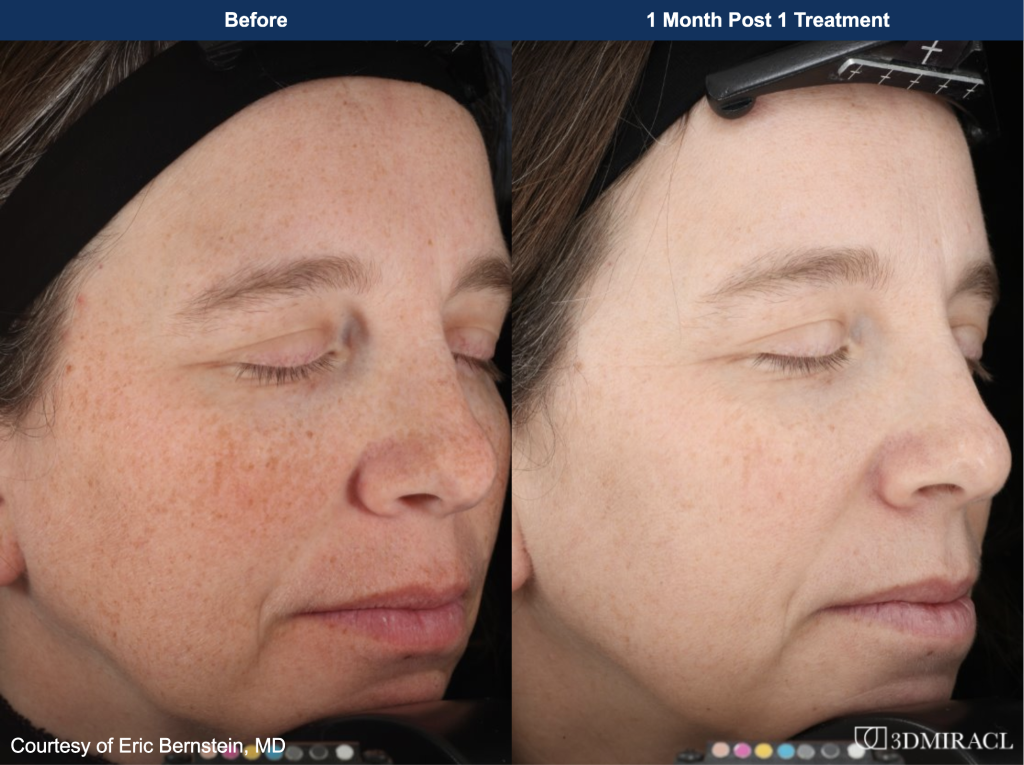
If you’ve started looking into treatments for sun spots or uneven skin, you’ve probably come across a long list of options: IPL, laser skin rejuvenation, fractional resurfacing, and a host of branded technologies, each promising clearer skin. It can be hard to know what any of them actually mean, let alone which one is right for you.
Some of these treatments help with similar concerns, but they work in different ways and at different levels of the skin. That’s why, at Helen Hunt Medical Aesthetics, we offer two different technologies: UltraClear® , our new laser resurfacing treatment, and UltraLUX PRO, which includes IPL. Having both means we can choose the approach that best suits your skin, your concerns, and your goals.
Skin resurfacing renews the skin by removing damaged cells from its surface, encouraging fresh, healthier skin to form as it heals.
Modern “fractional” resurfacing treats the skin in thousands of tiny, precise zones rather than all at once. The untouched skin in between helps it recover more quickly. As well as renewing the surface, this healing process encourages the skin to produce new collagen over the following months.
UltraClear® takes this a step further by offering three levels of treatment in one laser:
Rather than one fixed intensity, your treatment can be tailored to what your skin needs.
IPL stands for Intense Pulsed Light. Rather than a single laser beam, it uses a broad spectrum of light that is absorbed by pigment (melanin) and by the tiny blood vessels in the skin. This gently heats and breaks down unwanted pigment and redness, without removing the skin’s surface. Treated brown spots often darken slightly, then naturally flake away over the following week or two.
Our UltraLUX PRO platform uses IPL to treat pigmentation and sun damage , redness and rosacea , and general skin rejuvenation. It is usually carried out as a course of treatments, with minimal downtime.
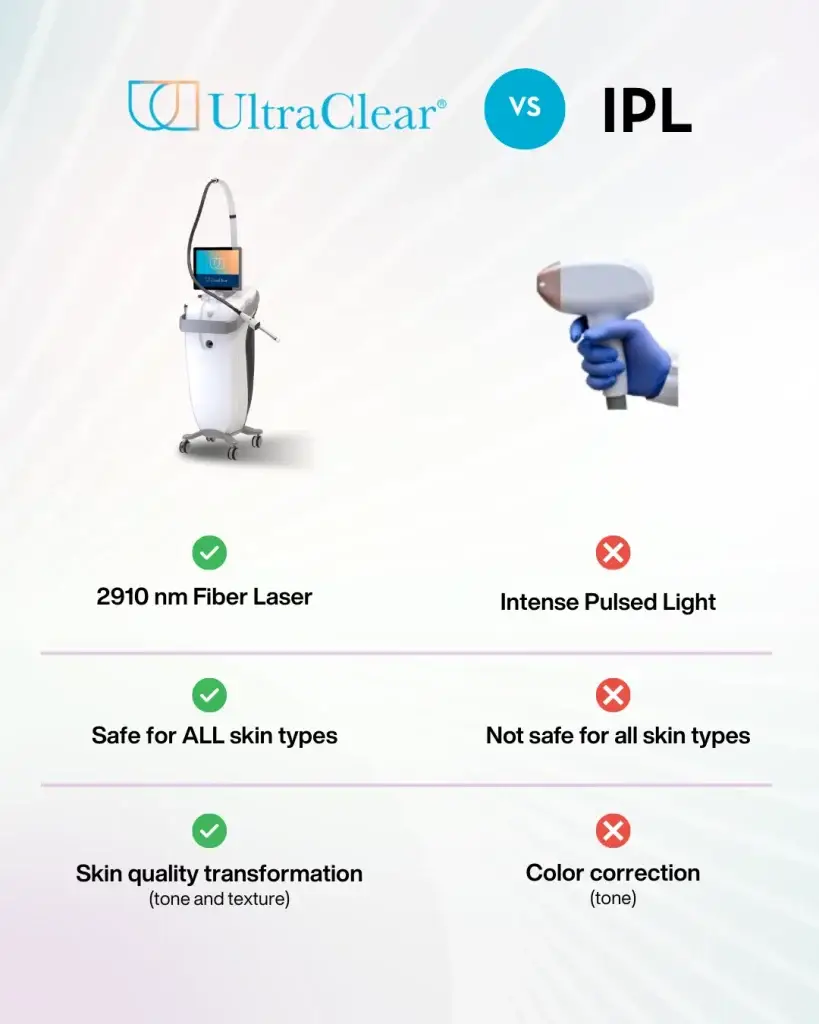
In short, UltraClear® is a skin-resurfacing laser, while UltraLUX PRO is a multi-technology platform that gives us IPL alongside several other treatments, including laser hair removal and radiofrequency. Here’s how the two compare for skin rejuvenation:
| UltraLUX PRO (IPL) | UltraClear® |
Type of treatment | Intense pulsed light | Cold fibre laser resurfacing |
How it works | Light targets pigment and redness beneath an intact surface | Precise laser zones renew the skin and encourage collagen |
Often used for | Sun spots, freckling, redness, rosacea, general rejuvenation | Sun damage, pigmentation, uneven texture, fine lines, acne scars |
Resurfaces the skin? | No | Yes |
Treatment intensity | Adjusted to your skin, usually as a course | Three levels, from a light refresh to advanced treatment |
Recovery | Minimal; mild redness, and spots darken before flaking | From minimal up to 10 days, depending on the level |
Skin types | Best suited to lighter skin types | Lighter and moderate treatments are suitable for all skin types, with settings tailored to you |
Years of UV exposure build up in the skin, showing as brown spots, freckling and a generally uneven or dull tone. IPL can work well for pigment on its own. However, when sun damage has also affected the texture and quality of the skin, resurfacing can treat both at the same time. UltraClear® removes damaged surface cells while encouraging fresh skin to form, helping to reveal a clearer, more even complexion.
Rough, uneven or congested-looking skin is often a sign that the skin’s natural renewal has slowed down. Because IPL works beneath the surface, it isn’t designed to change skin texture. UltraClear® resurfaces the skin, smoothing its surface and helping to refine the look of enlarged pores. Many people find their skin looks and feels smoother within a couple of weeks.
Acne scars aren’t simply a colour change. They alter the structure of the skin, leaving dips, pits or uneven areas, so they need a treatment that works on texture and collagen rather than one aimed only at pigment or redness. UltraClear® can be set to work deeper in the skin, encouraging it to rebuild and gradually softening the appearance of scarring over a course of treatments.
Resurfacing can improve visible fine lines and crepey skin at the surface, while also encouraging longer-term collagen renewal beneath it. Collagen continues to rebuild for around three to six months after treatment, so results tend to keep improving over time. For deeper lines and more advanced signs of ageing, Laser-Coring™ offers a more intensive option, without surgery.
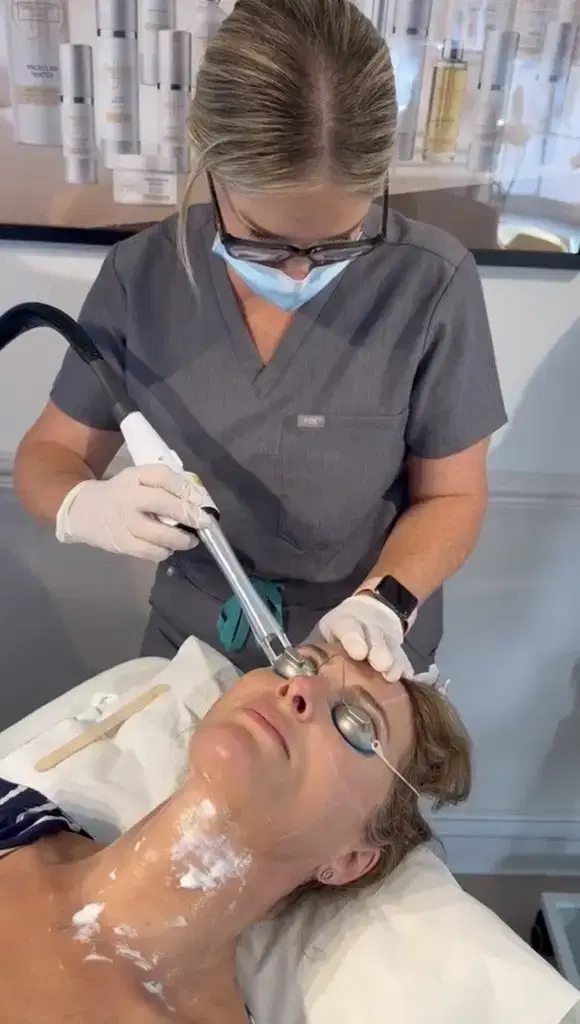
Traditional resurfacing lasers rely on heat, which can mean more discomfort, a longer recovery and, for some skin types, a higher risk of pigment changes.
UltraClear® is the world’s first cold ablative fractional fibre laser. It works at a 2,910nm wavelength, which is very strongly absorbed by the water in the skin. This allows it to treat the skin precisely while sending far less heat into the surrounding tissue.
That’s why it can be used across all skin types, and why treatments are typically more comfortable — lighter treatments often need no numbing cream at all. In the UltraClear’s patient data, people having the lightest treatment, 3DMIRACL®, rated their discomfort at an average of 1.75 out of 10.
UltraClear® was also named Best Laser Treatment for All Skin Tones in the NewBeauty Awards in 2023, 2024 and 2026.
Not necessarily. Because UltraClear® can be used at different intensities, recovery depends on the level of treatment chosen:
We’ll always talk you through what to expect, so you can plan your treatment around your life.
There isn’t one right answer for everyone. The best option depends on what is causing your pigmentation, whether texture or scarring is also a concern, your skin type, the result you’re hoping for, and how much downtime feels manageable.
For example, IPL may be ideal for sun spots and redness on otherwise smooth skin, while UltraClear® may be more suitable when pigment, texture, and fine lines all need attention, or for deeper skin tones. Some types of pigmentation, such as melasma, need particularly careful consideration.
That’s why every patient starts with a consultation with one of our experienced practitioners, including a patch test where needed, so we can recommend the treatment that’s right for you.
Introducing UltraClear® at Helen Hunt Medical Aesthetics gives us more ways to help with pigmentation, sun damage, uneven texture, fine lines and scarring.
With UltraClear® and UltraLUX PRO side by side, we’re not limited to a single approach. Instead, we can tailor your treatment to your skin, your goals and your lifestyle, always with our focus on safe, natural-looking results.
Discover UltraClear® Laser Treatment
No. IPL uses broad-spectrum light to target pigment and redness beneath the skin’s surface, while UltraClear® is a laser that resurfaces the skin. Each suits different concerns, and we offer both.
UltraClear® is the latest generation of resurfacing technology and a step on from traditional CO2 lasers. CO2 lasers rely on heat, which can mean a longer, more uncomfortable recovery and a higher risk of pigment changes, particularly in darker skin. UltraClear® uses cold fibre laser technology to resurface the skin with far less heat, so it can deliver excellent results with much less downtime.
Yes. UltraClear® can help improve sun damage, age spots, and uneven skin tone by renewing the skin’s surface. Some types of pigmentation, such as melasma, need careful consideration, so we’ll always check what’s right for you at your consultation.
Yes. UltraClear® can be set to work deeper in the skin, encouraging collagen renewal and gradually improving the texture of acne scarring. Most people benefit from a course of treatments.
UltraClear® lighter and moderate treatments are suitable for all skin types. Because it works with far less heat than traditional lasers, the risk of heat-related pigment changes is reduced. For our most advanced treatments, we’ll tailor the settings carefully to your skin.
It depends on the treatment level. With UltraClear®, it ranges from minimal downtime for a light refresh to three to five days for moderate treatments, and five to ten days for our most advanced option.